Data migration projects have a way of revealing exactly how unprepared a team was — not in the first week, but in week six, when the field mapping spreadsheet has grown to 400 rows, the data quality issues are piling up, and the project sponsor is asking why the schedule slipped.
The problems that derail migrations are rarely technical. They're the questions no one thought to ask in the planning phase. Who owns this dataset? What transformation logic applies to this field? How are we measuring quality before we validate anything?
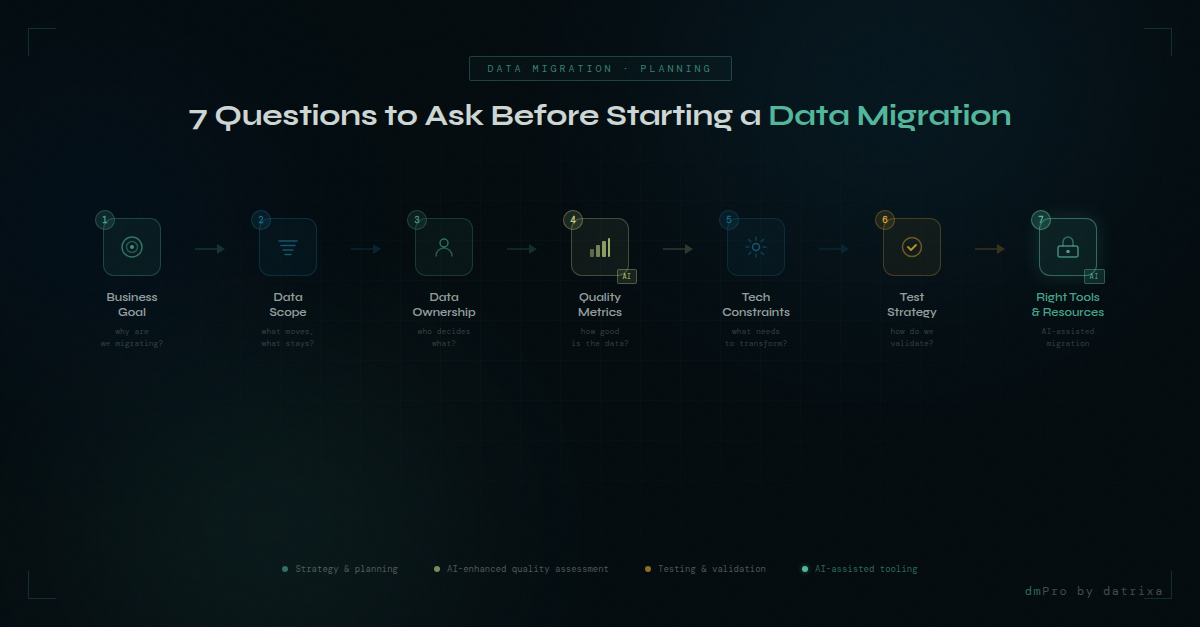
Seven questions separate migrations that land cleanly from migrations that spiral. They won't take long to ask. But most teams skip them — and spend months paying for it.
1. What Is the Business Goal Driving This Migration?
Every migration should serve a clear business purpose — improving reporting, reducing operating costs, enabling a new platform, meeting a compliance requirement. If the team can't articulate the goal in one sentence, that's worth resolving before anyone touches data.
Without a defined business goal, technical decisions drift. The scope expands. Stakeholders disagree about what "done" looks like. Getting alignment on the why before the work starts saves everyone from those conversations in sprint reviews.
2. What Data Needs to Be Migrated — and What Doesn't?
Migrating everything "just in case" is one of the most common and costly mistakes in large-scale migrations. Obsolete records, duplicate entries, and abandoned legacy data all have carrying costs on the target system — and none of them were worth moving.
Scoping data migration used to mean manual sampling and spreadsheet analysis. Modern data migration tools can profile source tables automatically, surfacing null rates, cardinality, value distributions, and duplicate patterns across millions of records before any mapping work begins. That profile changes the scope conversation: instead of arguing about what might matter, the team works from evidence.
Define clear data retention, cleansing, and de-duplication rules in the planning phase. The scope decisions made here determine how much downstream work gets created — or avoided.
3. Who Owns the Data?
Many migrations hit roadblocks because no one knows who is responsible for specific datasets. Identifying data owners isn't a bureaucratic step — it's a prerequisite for every substantive decision that follows.
Data owners make the call on transformation logic, resolve ambiguous business rules, and sign off on data quality findings. Without them, those decisions default to whoever is closest to the keyboard — which means they get made inconsistently, often incorrectly, and sometimes without the authority to stick.
Assign data stewards early. Map ownership to the datasets before the mapping work starts.
4. How Will Data Quality Be Measured — and Improved?
Migrating poor-quality data doesn't fix the quality problem — it relocates it. The target system inherits every null, every duplicate, every inconsistently formatted value from the source.
Establishing data quality metrics — completeness, accuracy, consistency, referential integrity — sounds obvious, but most teams postpone it until the testing phase. By then, the migration logic is already built around whatever the source data contained.
AI-assisted profiling changes this calculus. Tools that can automatically flag anomalies, identify outliers, and surface value-frequency patterns give migration teams a real quality baseline before the design phase begins. That baseline drives cleansing decisions, informs transformation rules, and establishes the acceptance criteria for post-migration validation. Starting with the data as it actually is — not as the team assumes it is — is the difference between testing that confirms success and testing that discovers surprises.
5. What Are the Technical Constraints and Opportunities?
The source and target systems rarely align as cleanly as the architecture diagrams suggest. Data formats differ. Field lengths change. Reference tables get renamed or consolidated. What was a free-text field in the legacy system now has a controlled vocabulary in the target.
Understanding these constraints before mapping begins — not during — is what separates a technical discovery phase from a technical crisis. It's also where opportunity lives: migration is one of the rare moments when rationalizing data structures, enforcing consistency, and retiring legacy workarounds is actually feasible.
Perform a thorough discovery pass on both systems. Document what needs to transform, what can be simplified, and what will require custom logic.
6. How Will We Test the Migration?
Migration testing is not ETL testing. Verifying that records transferred is the baseline. The real test is whether the data retained its meaning in the new context — whether business rules hold, whether relationships are intact, whether the reports that management relies on produce the right numbers.
Plan for multiple test cycles. Include business users in acceptance testing — they're the ones who know what the data should look like when it's correct. Build in time for rework, because the first test cycle almost always finds something. The teams that plan for rework hit their deadlines. The teams that assume they won't need it don't.
7. Do We Have the Right Tools and Resources?
This question gets answered too late and too narrowly. "Tools" usually means the ETL platform. "Resources" usually means developers. But a complex migration needs project management, data analysis, business involvement, quality assurance — and a coordination layer that keeps all of it moving together.
Spreadsheets and ad hoc SQL scripts don't scale. At a certain volume, the mapping decisions alone — hundreds or thousands of field-by-field transformation rules — become unmanageable without structured tooling.
dmPro was built specifically for this problem. It brings field mapping, data profiling, transformation documentation, and migration job management into a single environment — with AI-assisted features that accelerate the most time-consuming parts of the work. AI mapping suggestions propose target fields based on name patterns, data type compatibility, and value matching, compressing the manual effort of initial mapping passes. AI-generated field descriptions give the team a starting point for documenting transformation logic, rather than building that documentation from a blank page.
The goal isn't to automate the decisions. It's to give the people making those decisions better information, faster — so they're spending time on judgment rather than data collection.
Migrations don't fail because teams couldn't answer these questions. They fail because no one thought to ask them before the first record moved.
The questions above aren't new. Migration practitioners have been wrestling with them for decades. What's changed is the tooling available to answer them: automated profiling that surfaces data quality issues before the design phase, AI assistance that compresses the mapping cycle, and workflow management that keeps analysts, developers, data stewards, and business owners moving in the same direction.
Asking the right questions is half the work. Having the tools and process to systematically work through the answers is the other half.